
Foreign direct investment in Thailand’s high-tech manufacturing surged in the first half of 2026, driven by global supply chain diversification and escalating demand for artificial intelligence hardware across Southeast Asia.
Realized capital expenditure reached $16.11 billion (530 billion baht) in the first six months of the year, with AI-linked sectors - spanning optical transceivers, photonics, high-capacity hard disk drives, and printed circuit boards (PCBs) - accounting for half of that total. BOI unveiled the investment momentum at the BOI Strategic Forum 2026, held during the Thailand Electronics Circuit Asia (THECA 2026) summit in Bangkok.
Thailand’s Board of Investment (BOI) confirmed that the National Semiconductor and Advanced Electronics Board will convene within the next two weeks to review and finalize the country’s comprehensive long-term roadmap, anchored around an ambitious "Made in Thailand Chips” framework.
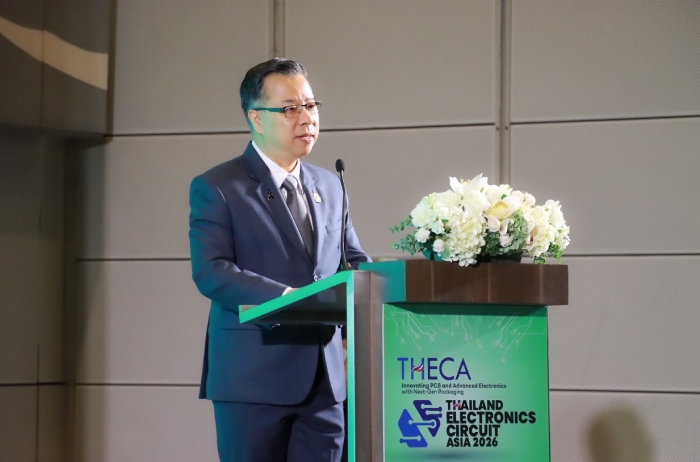
Addressing international delegates, Mr. Narit Therdsteerasukdi, Secretary General of the Thailand Board of Investment, outlined a structural shift in global manufacturing where artificial intelligence is moving beyond hyperscale cloud servers into physical edge systems, industrial automation, and software-defined electric vehicles.
"We are witnessing a synchronized global structural transformation driven by geopolitical realignment, supply chain redesign, the green transition, and the exponential rise of physical AI,” Mr. Narit said. "Our objective is to move from simply utilizing technology to co-creating it. We are building a deep, interconnected ecosystem so that the economic value created by intelligent devices stays in Thailand.”
Highlighting the rapid evolution of modern mobility and connected devices, he emphasized the broader economic opportunity for domestic suppliers: "When we talk about future mobility, the shift to electric vehicles is far more than replacing an engine with a motor — it is turning the automobile into an intelligent digital platform. Our priority is ensuring that the immense value generated from advanced electronics, smart sensors, and software systems is rooted directly here in Thailand.”
To accelerate capital deployment, the government has rolled out the "Thailand FastPass” initiative across eight key state agencies - including Customs, the Department of Industrial Works, and power utilities - slashing regulatory approval times by 20% to 50% for high-impact projects. The government has also paired these regulatory corridors with its "Skill Bridge” grant program, funding 35 targeted training curricula to upskill more than 60,000 engineers and technical workers. In the first half of 2026 alone, the BOI approved 132 smart and sustainable manufacturing projects worth $516.8 million (17 billion baht) to modernize equipment, adopt clean energy, and integrate advanced automation.
Academic and corporate partnerships are already mirroring this pivot. Eight Thai universities have launched dedicated semiconductor engineering degree programs alongside new postgraduate faculties in photonics engineering. European aerospace giant Airbus has expanded its regional engineering and technical design headquarters in Bangkok.
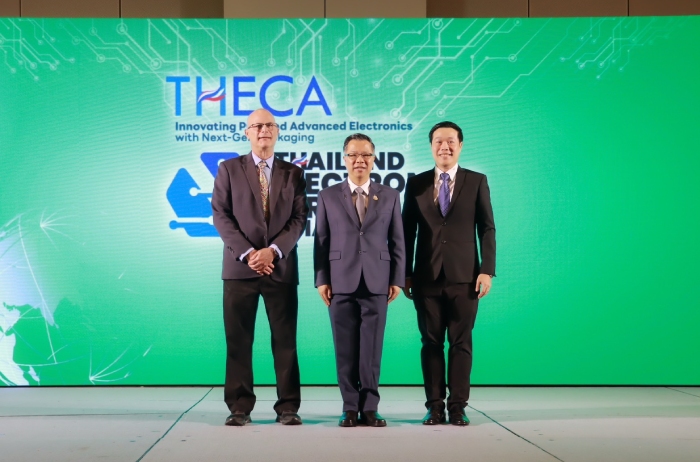
In his keynote address, Mr. David Bergman, Vice President of the Global Electronics Association (GEA) and Secretary General of the World Electronics Circuits Council (WECC), stressed that the ongoing realignment of global electronics requires nations to focus on ecosystem integration rather than trying to replicate another country's model.
"The defining competition of the next decade will not be factory against factory - it will be ecosystem against ecosystem,” said Mr. Bergman. "Thailand does not need to copy other manufacturing models - it should unite its established strengths across automotive, PCB manufacturing, and packaging into a durable architecture.”
Mr. Bergman noted that edge AI semiconductors are projected to reach $150 billion within a decade, with advanced packaging approaching $80 billion by 2033. Thailand's output of over $5 billion in printed circuit boards in 2025 positions it well as Southeast Asia's leading PCB base. "Success will be determined not merely by the volume produced, but by the electronic intelligence designed, validated, and manufactured locally,” he added.
A cross-industry executive panel emphasized that Thailand’s high-tech transition hinges on mastering critical architectural shifts while securing deep supply-chain integration.
On the design front, Dr. Aroonchat Chatchaikarn, CEO of Lancelot IC and System Corp., Ltd., urged targeting high-margin niches in Co-Packaged Optics (CPO) to solve surging AI power and data constraints.
That momentum extends directly to the production line: Dr. Prong Kongsubto, Senior Director and Chief of Staff at Lumentum International (Thailand) Co., Ltd., noted that the global shift from copper to optical signaling creates an immediate runway for Thai plants to scale photonics for AI data centers.
These performance gains depend on next-generation packaging. Dr. Wutthinan Jeamsaksiri, Principal Researcher at TMEC, emphasized upgrading local facilities to 2.5D, 3D, and photonics-integrated packaging to capture higher margins.
Sustaining this expansion demands a massive talent ramp-up. Prof. Surin Khomfoi, Ph.D., Vice President of NXPO, pointed out that the agency is expanding its "Siam Silica" initiative across 13 universities to bridge the gap between 12,000 annual engineering graduates and long-term demand reaching hundreds of thousands.
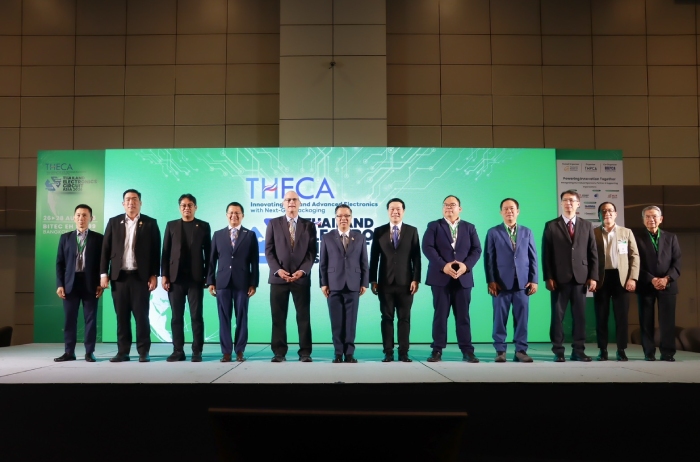
Anchoring these investments locally remains the final hurdle. Mr. Pornpisit Nitisupornrat, Board Member of THPCA and Assistant General Manager at Circuit Industries Co., Ltd., called for policies that pair foreign entrants with qualified Thai PCB makers. Mr. Tongchai Chuenchujit, General Manager of Plexus (Thailand) Co., Ltd., noted that as EMS providers evolve into full-stack product design, specialized local engineering talent will be the decisive factor.
THECA 2026 convened more than 300 exhibiting enterprises from 11 countries and 7,000 international delegates across 40 nations, generating an estimated $608 million (20 billion baht) in trade and business transactions.
Reflecting the country's rising industrial stature, Thailand has been selected to host the 17th Electronic Circuits World Convention (ECWC17) in August 2027 — the triennial global summit rotating exclusively among the world's leading electronics manufacturing economies.
